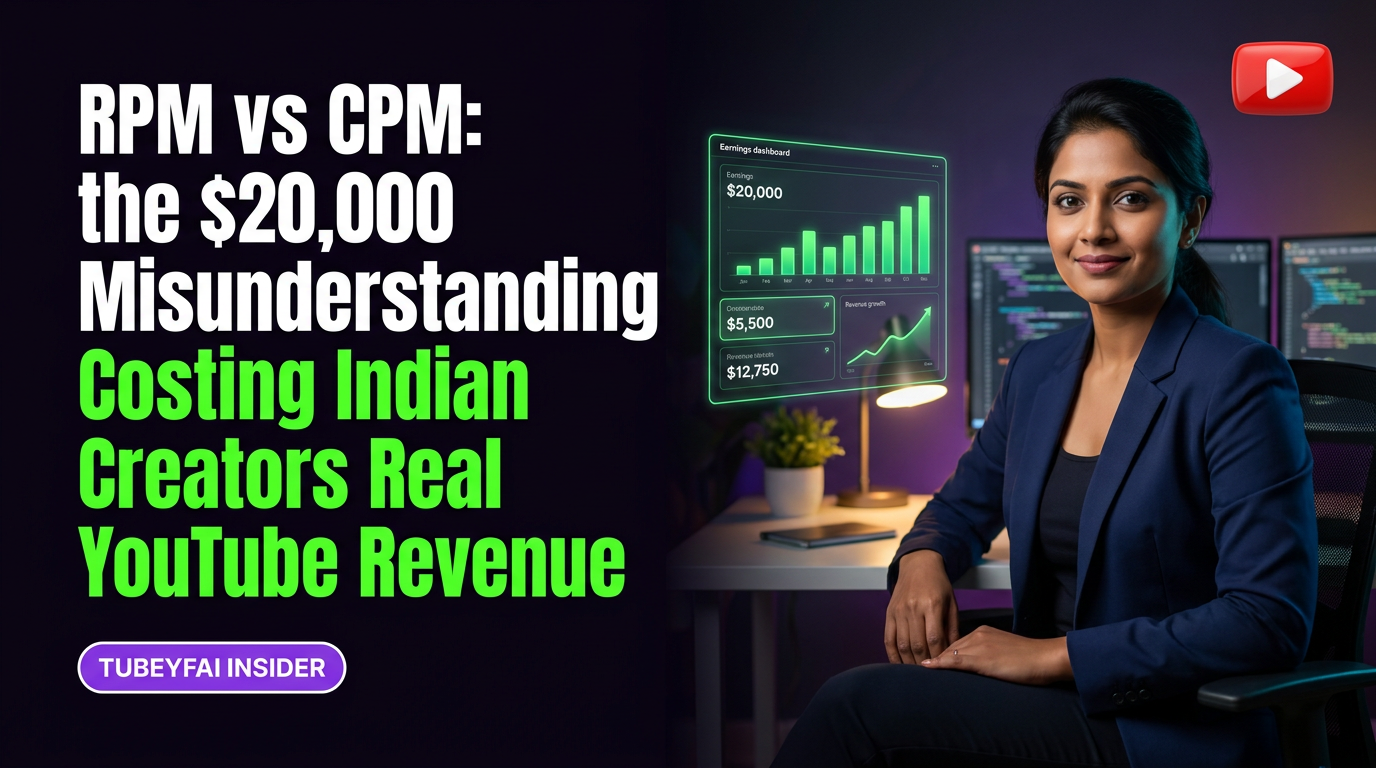
RPM vs CPM: the $20,000 Misunderstanding Costing Indian Creators Real YouTube Revenue
Why Most Indian Creators Misread Their Earnings—and How to Fix It for Better Monetization
I remember my first YouTube payout. I’d spent weeks obsessing over CPM stats, running calculations in spreadsheets, and dreaming of my “inevitable” five-figure months. But when the actual earnings landed, reality hit hard: the numbers didn’t match my projections at all. My mistake? Confusing CPM with RPM—a blunder I now see everywhere among Indian creators building faceless channels for high-CPM geographies.
If you’ve ever wondered why your real income lags behind your ad revenue estimates, you’re not alone. The difference between CPM (Cost per Mille) and RPM (Revenue per Mille) is more than just an accounting technicality—it’s the dividing line between wishful thinking and sustainable channel strategy. Let’s unpack what these metrics really mean, where most creators go wrong, and how to finally get clarity on your true earning power.
The Two Numbers That Shape Every Creator’s Income
What Is CPM?
CPM stands for Cost per Mille, or cost per thousand impressions. In plain English: it’s what advertisers pay YouTube for every 1,000 times their ad is shown—whether or not you get paid that full amount.
Reported ranges: Across US and Tier-1 niches like finance, tech, and health, CPMs can be anywhere from $8–$80, depending on seasonality and channel audience.
What it measures: The gross rate before YouTube takes its cut or accounts for non-monetized views.
What Is RPM?
RPM stands for Revenue per Mille, or revenue per thousand views—for you, the creator.
Reported ranges: In high-CPM niches targeting US viewers, RPMs are often $3–$25, though some channels in finance/tech report up to $45 based on community patterns.
What it measures: Your actual revenue divided by total views (including those without ads or demonetized).
This is the number you should be tracking if you care about money in your bank account—not just hypothetical ad rates.
How These Metrics Are Calculated (And Why It Matters)
The CPM Formula
Advertiser Spend ÷ Number of Ad Impressions × 1,000 = CPM
You don’t control this directly—it fluctuates based on advertiser demand, time of year (Q4 is usually highest), viewer location (US/Tier-1 gets the best rates), and niche relevance.
The RPM Formula
(Total Revenue ÷ Total Views) × 1,000 = RPM
This includes:
Ad revenue
YouTube Premium payouts
Channel memberships
Super Chats (for livestreams)
Critically: RPM uses all views as the denominator—even those where no ad was shown.
Where Most Creators Go Wrong: The Dangerous Assumptions
In workshops with hundreds of Indian creators breaking into US markets, I see these misconceptions again and again:
Assuming CPM = Take-home Pay: Many plan content investments using CPM figures they find online ($30–50+), only to discover actual payouts are much lower once YouTube takes its share.
Ignoring Non-Monetized Views: Not every view triggers an ad—kids’ content, low-engagement traffic, or viewers using ad blockers won’t generate earnings but still count toward your total views.
Not Factoring Platform Cuts: YouTube keeps about 45% of ad revenue; creators receive only 55%. This gap turns a $40 CPM into a much lower RPM.
Overestimating Niche Effects: Even in a “high-CPM” niche like finance or tech targeting US audiences, RPM will always lag behind the best-case CPM scenario due to these deductions.
Result: Over-projected income forecasts—sometimes by a factor of two or three—and disappointment when actual payments arrive.
Real Data: What High-Earning Faceless Channels Actually See
Across patterns in my Silver and Diamond communities focusing on US Tier-1 viewers:
Finance/Tech/Education Niches:
Reported CPM: $35–80
Typical RPM: $12–25
Outlier max RPMs (rare): Up to $45 for short bursts during Q4
General Entertainment/Storytelling:
Reported CPM: $8–18
Typical RPM: $2–6
Composite example:
A faceless personal finance channel targeting US viewers might clock a \(60 average CPM but see a monthly average RPM closer to \)19 after all deductions—even with strong watch time and engagement.
Timeline: When Will You Actually See Results?
Let’s break down realistic growth phases:
Months 1–3: Laying Foundations
Focus: Content output (aim for at least 12–15 quality videos)
Expectation: Little to no monetization; building initial traction
Metrics obsession here hurts more than helps—prioritize consistency over chasing CPM spikes
Months 4–6: Hitting Monetization Thresholds
First AdSense payout possible if you hit 4,000 watch hours + 1K subscribers
Early data emerges; expect wild swings in both CPM and RPM as inventory stabilizes
Composite case: Channels start seeing monthly payouts ranging from $150–800 depending on niche and upload frequency
Months 7–12: Scaling With Data
Patterns stabilize; average out seasonal surges/drops
Strong channels begin hitting $2,500–8,000/month if consistently posting high-demand content in lucrative verticals
By now you’ll know your real-world average RPM—not just projections
Year 2 Onward: Systematizing Growth
Advanced optimization (longer videos for mid-rolls; audience retargeting)
Mature faceless channels can scale to $8,000–20,000/month reported range in top niches—but only if you optimize around real RPM data rather than chasing theoretical CPM highs
Who This Fits Best
This strategic focus benefits:
Indian creators targeting US/Tier 1 audiences with faceless video formats
Digital marketers aiming to build automated channel portfolios with predictable income streams
Ambitious solo founders ready to invest months of effort before scaling up teams or automation systems
Anyone frustrated by unpredictable income who wants actionable clarity—not hype-driven guesswork—on real earnings potential
Who This Does NOT Fit
It’s not ideal if:
You rely on viral shorts/reels without intent to monetize via long-form content (RPM is far lower)
Your primary audience is outside Tier 1 countries (India-only traffic typically earns far less)
You expect instant results—realistic ramp-up takes consistent effort across several months before substantial payouts begin flowing
You dislike analytics/deep dives into platform data; surface-level tracking leads back to old misconceptions fast!
Avoiding Pitfalls: Common Traps That Kill Creator Earnings
Every week I see talented creators fall into these traps:
Chasing High-Cost Niches Blindly: Picking topics solely because they “pay well” without understanding the true RPM potential after all deductions almost always backfires—especially if you lack expertise or passion for those topics.
Focusing Only on Views: A million views from non-Tier 1 countries may yield less than 100K targeted US views with strong engagement. Always check where your audience comes from!
Neglecting Optimization Levers: Simple tweaks like increasing video length (to add mid-roll ads) or improving click-through rates can boost both raw views and effective RPM over time—but only if measured against your actual channel data.
The Strategic Edge: Use Real Metrics for Smarter Growth Decisions
When you stop fixating on flashy CPM screenshots and dig into your own dashboard’s RPM trends, everything changes:
You’ll budget content investments realistically.
You’ll set team/freelancer targets around sustainable earnings—not wishful thinking.
You’ll have confidence pitching sponsors based on proven take-home rates instead of vague averages.
Best of all? You’ll join the small percentage of creators who actually know what their business is worth—and scale faster while others stay stuck guessing.
Have You Been Surprised by Your Actual Earnings?
If so—you’re not alone! Share your experience or questions about RPM vs CPM below. Clearing up this confusion is one of the fastest ways to unlock smarter monetization strategies—and finally get paid what your content deserves.
Ready to go deeper?
Join my Free Webinar this Saturday — AI YADI Income Growth Matrix.
About the author
- Aviation-Professional-Turned-AI-YouTube-Automation-Coach who's spent 9+ years turning knowledge into income through YouTube, AI Agent Automation, Digital Products, Instagram — YADI without ever showing his Face.
Niche Research
How to find and validate high-CPM YouTube niches that pay in USD — data-driven niche selection strategies for faceless channels targeting US and Tier-1 audiences.