7 AI Video Tools That Can Replace a Full Production Team (and Save $20,000+)
How solo creators and lean agencies are automating every stage of video production—without sacrificing quality or creativity.
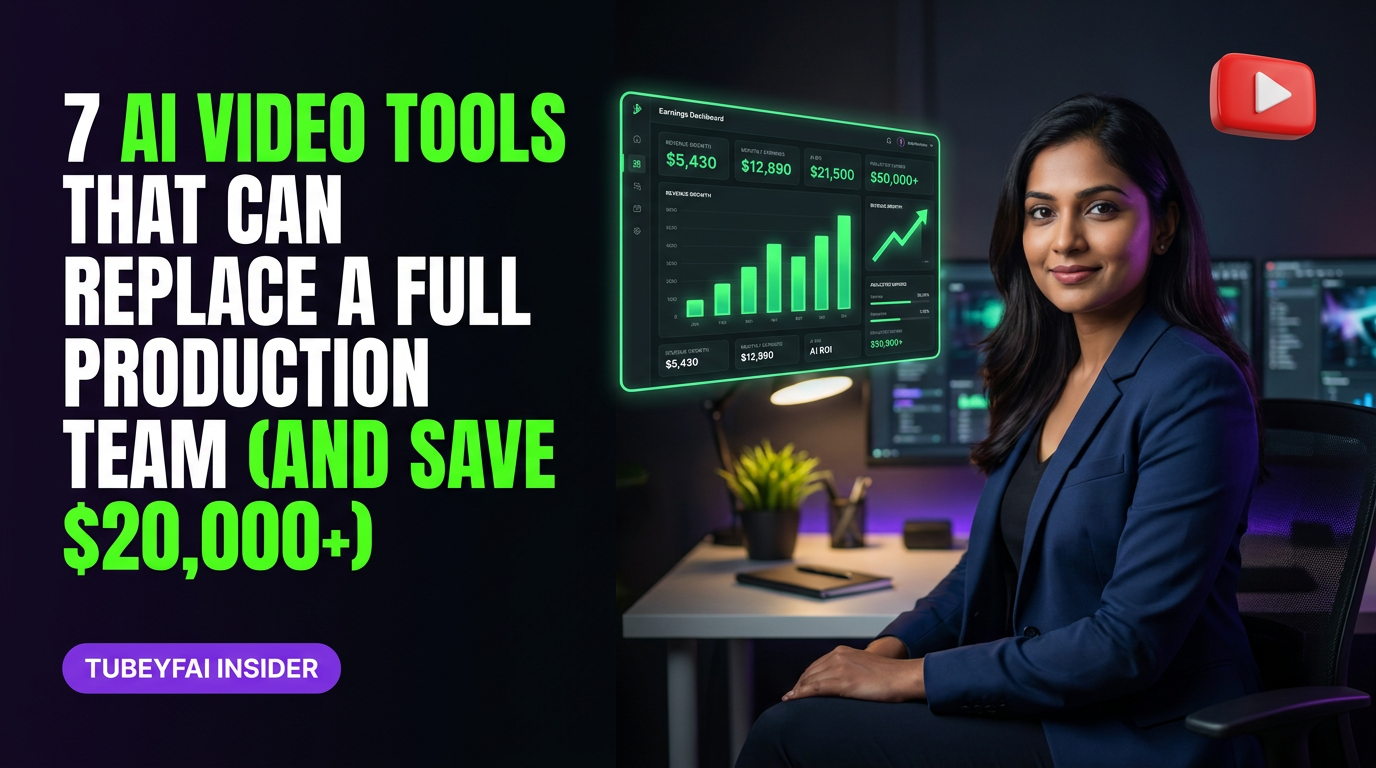
Imagine producing a high-impact explainer video for a US-based client in just hours—not weeks—without hiring scriptwriters, editors, animators, or voice artists. Last month, I watched a single creator churn out twelve polished videos using nothing but AI tools. Their total spend? Less than what most agencies charge for one project. If you’ve ever wondered whether the promise of full-stack AI video automation is hype or reality, this breakdown is your roadmap.
Why AI Video Production Is Exploding Now
The last 18 months have brought a tidal wave of AI innovation. Large language models can now write scripts that rival agency copywriters. Generative visuals mimic custom animation styles on demand. Text-to-speech engines deliver broadcast-quality narration in dozens of accents and tones. All this means solo creators and small teams can produce studio-quality content at a fraction of old costs.
What’s driving this change?
Advertiser demand for fast-turnaround content (especially in high-CPM niches like SaaS, finance, and tech)
The race to dominate YouTube automation, where output volume directly impacts revenue
New AI platforms that bundle scripting, editing, and graphics into one seamless pipeline
Reported ranges from industry benchmarks show production cost drops of 70-90%, while CPMs in US-facing niches still hold strong at $45–80.
The Seven Core Roles AI Can Now Automate
Let’s break down the traditional team—and the latest toolsets replacing them:
Scriptwriter: ChatGPT-4, Jasper.ai
Generate audience-tailored scripts with SEO optimization and brand voice control.
Storyboard Artist: StoryboardHero, Tome
Instantly convert scripts to visual storyboards for approval before production starts.
Voice Artist: ElevenLabs, Murf.ai
Produce realistic human narration in dozens of accents and emotional tones.
Video Editor: Descript, RunwayML
Cut, trim, add effects—or generate entire sequences—from text prompts.
Motion Graphics Designer: Pictory.ai, Synthesia
Create branded intros/outros and animated explainers without After Effects expertise.
Stock Footage/Asset Sourcing: Envato Elements + Stable Diffusion
Find or generate unique visuals on demand; no more endless stock library browsing.
Project Manager: Notion AI Workflows
Keep content calendars on track with automated reminders and task assignments.
Each of these tools has matured rapidly since late 2022—now delivering results previously only possible with multi-person teams charging $8,000–$20,000 per month.
Inside an End-to-End AI Video Workflow
Here’s how a typical production might look today:
Input your topic into ChatGPT-4 for a script tailored to your channel niche (finance/tech/SaaS)
Feed the script into StoryboardHero for instant shot suggestions
Use ElevenLabs to generate natural-sounding English narration with your preferred accent
Import assets from Envato Elements or generate fresh images via Stable Diffusion
Pull everything into Descript or RunwayML for editing—letting AI handle scene transitions and even B-roll placement
Add motion graphics through Pictory.ai or Synthesia for polish
Automate project tracking and deadlines in Notion AI
This streamlined stack empowers one person to do the work of five—in less time—with far fewer revisions.
Timeline: How Fast Can You Go From Zero to Fully Automated?
Months 1–3: Experimentation & Tool Stacking
You’ll start by testing several tools side-by-side—identifying which ones mesh best with your workflow and target niche. Expect to produce 4–6 test videos as you refine your process.
Months 4–6: Scaling Output & Cost Savings
With your stack set up, ramp up publishing frequency—12–15 videos/month is common among community members at this stage. Average reported cost savings compared to hiring freelancers: 75%. CPMs trend toward the $45–80 range as quality stabilizes.
Months 7–12: Brand Differentiation & Advanced Automation
Begin layering custom prompts for deeper brand voice consistency across scripts and visuals. Integrate API-driven automations (e.g., direct upload from editor to YouTube). Many creators hit $8,000–20,000/month gross revenue here if targeting Tier-1 audiences.
Year 2 Onward: Creative Expansion & Multi-Niche Replication
Extend your system into new verticals or languages; some build “channel farms” using cloned workflows. Human oversight shifts toward strategy rather than day-to-day production.
Real Data: Reported Ranges Across Faceless Channels
In my Silver and Diamond communities focused on US/Tier-1 faceless channels:
Production costs per video drop from ₹25k–40k ($300–500) down to ₹5k–10k ($60–120) after full automation.
Monthly channel revenues grow from near zero to ₹6L–16L ($8k–20k) within 9–12 months when targeting finance/SaaS/tech niches.
Time spent on each video falls under four hours—including ideation, scripting, editing, and upload—once systems are dialed in.
These are reported ranges based on publicly available advertiser benchmarks and self-reported data from active creators.
Who This Fits
You’ll benefit most if you:
Are willing to learn new tools quickly (no advanced coding required)
Target high-value niches (finance/SaaS/tech/education) with English-first content
Value speed-to-market over custom hand-crafted animation
Want maximum cost efficiency while scaling output
This approach is especially powerful for solo creators looking to punch above their weight—or lean agencies serving global clients with tight turnaround times.
Who This Does NOT Fit
AI-driven video automation isn’t ideal if:
Your projects require hyper-custom live-action footage or celebrity talent
You need ultra-specific brand guidelines enforced frame-by-frame
Your audience expects hand-drawn art or heavily stylized visuals outside current generative capabilities
You’re resistant to experimenting with new tech stacks or adapting as tools evolve rapidly
If you’re committed exclusively to traditional filmmaking craft—or need Hollywood-level post-production polish—the all-AI route may not meet expectations…yet.
Future Trends: Where Is This Headed Next?
Expect rapid gains in:
Multimodal generation (combining text + image + audio seamlessly)
Real-time collaboration between human directors and AI assistants inside editing suites
Hyper-personalized video variants at scale (e.g., tailored intros/outros per viewer segment)
Open-source models will keep lowering barriers so even non-English regional creators can tap global markets soon.
For those embracing the shift now? You’re positioned ahead of the curve—before mainstream saturation drives competition sky-high.
Your Next Steps: Building Your Own Stack
Start simple:
Pick one role to automate first (scriptwriting or voiceover is often easiest)
Integrate adjacent tools gradually—don’t overwhelm yourself trying everything at once
Track performance metrics (time saved per video; cost reduction; CPM movement)
Connect with communities sharing prompt templates/workflows specific to your niche
Remember: perfectionism kills momentum more than any technical hurdle ever will.
Are you ready to let AI shoulder the grunt work so you can focus on strategy and creative vision? Or will you cling to manual processes while competitors leapfrog past?
The choice is yours—and the opportunity window is wide open right now.
Ready to go deeper?
Join my Free Webinar this Saturday — AI YADI Income Growth Matrix.
About the author
- Aviation-Professional-Turned-AI-YouTube-Automation-Coach who's spent 9+ years turning knowledge into income through YouTube, AI Agent Automation, Digital Products, Instagram — YADI without ever showing his Face.
AI Tools
The best free and paid AI tools for building, scaling, and automating faceless YouTube channels — tested, reviewed, and ranked by the Tubeyfai community.