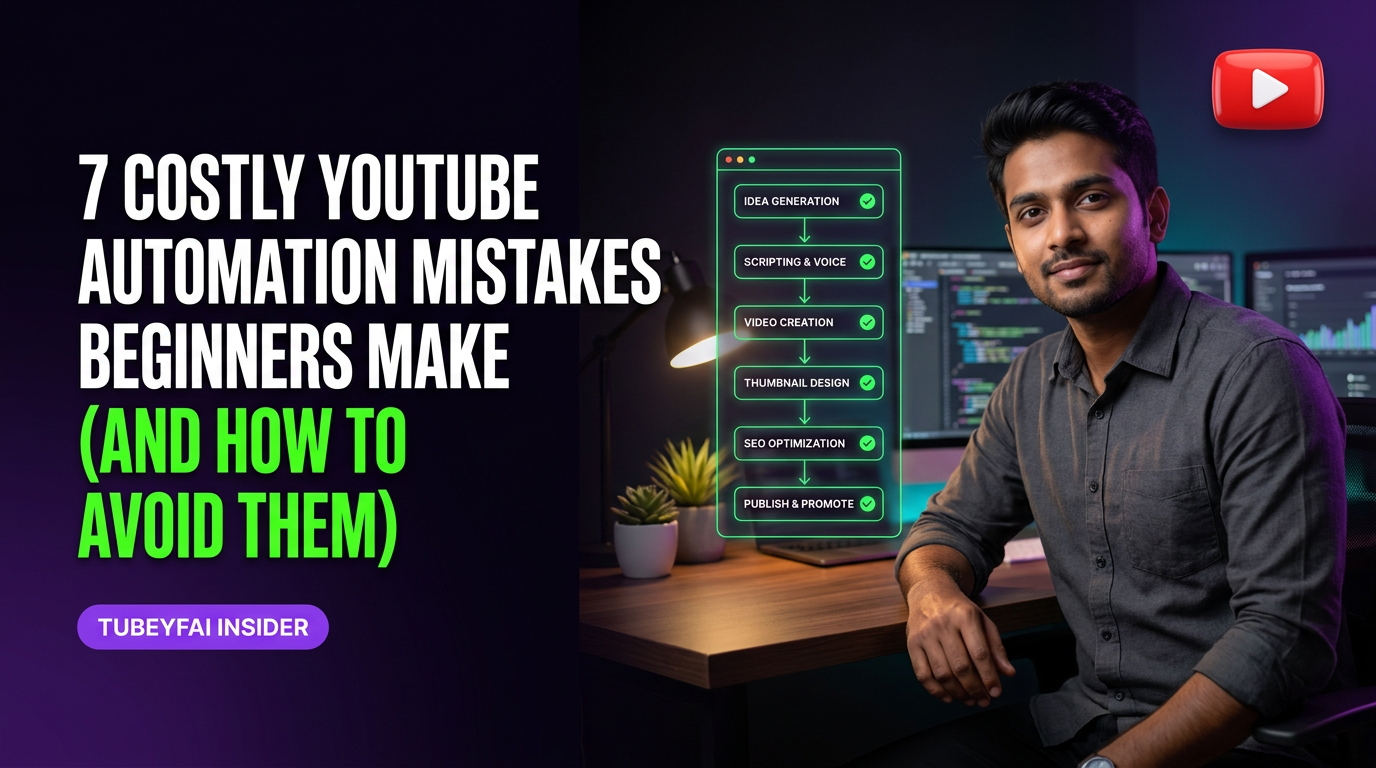
7 Costly YouTube Automation Mistakes Beginners Make (And How to Avoid Them)
Avoid These Hidden Pitfalls to Build a Faceless Channel That Grows Faster, Earns More, and Stays Safe
Are You Sabotaging Your Channel Without Realizing It? Five years ago, I made my first foray into YouTube automation with visions of $8,000/month passive income and viral videos. Within three months, I was staring at a channel that barely moved past 400 views per video—and a mounting sense of frustration. Turns out, the right automation can scale your channel, but the wrong moves will quietly kill momentum before you even get started.
If you’re building a faceless channel—especially targeting US or Tier-1 markets—avoid these common beginner mistakes that keep so many Indian creators stuck at low CPMs and stalled growth.
The Dream vs. Reality: What Most Beginners Get Wrong
Many new creators jump into YouTube automation lured by stories of quick cash and hands-off profits. The reality? Automation is leverage—not magic. If you skip foundational steps, automate the wrong tasks, or ignore feedback from your viewers and analytics, you’ll plateau fast.
Reported data across successful faceless channels in my Silver and Diamond communities shows that channels earning $45-80 CPM consistently avoid these traps. Let’s break down the biggest mistakes and show you how to sidestep them.
Mistake #1: Over-Automating Content Creation
The number one error? Believing AI tools alone can handle everything from scriptwriting to video editing—without oversight. Yes, AI speeds things up. But:
AI-generated scripts often lack nuance and engagement
Stock footage-only edits look generic and miss storytelling hooks
Automated voices sound robotic if not customized
When beginners hand over 100% control to automation tools, their videos blend into the crowd—and YouTube’s algorithm notices.
Fix: Humanize Your Process
Even with AI support:
Always add manual research for trending topics
Edit scripts for tone and flow
Use composite voiceovers or custom settings in TTS software
Add personal insights or hooks in introductions
Top earners report spending 30–40% of their time on creative review—even with automation running most steps.
Mistake #2: Ignoring Analytics Until It’s Too Late
Many treat analytics as an afterthought—checking dashboards only when views drop or revenue stalls.
But YouTube rewards creators who adapt quickly:
Audience retention under 40% signals poor content fit
Low CTR (click-through rate) means your thumbnails/titles need work
Sudden spikes/drops can indicate copyright flags or shadowbans
Fix: Build Analytics Into Your Workflow
Set aside time every week to track:
Top-performing videos (and why)
Watch time patterns by geography (targeting US/Tier 1)
Keyword trends using TubeBuddy/VidIQ
Channels that reach $8,000–20,000/month typically iterate based on analytics every 3–5 uploads—not just quarterly.
Mistake #3: Neglecting Originality (and Getting Penalized)
Faceless doesn’t mean faceless copies! Ripping scripts from Reddit threads or recycling popular B-roll gets flagged by both algorithms and viewers.
YouTube’s system is increasingly sophisticated at detecting reused content—leading to demonetization or “yellow icon” ads with CPMs under $8.
Fix: Layer Original Value
Every automated video should include:
New angles on trending topics
Custom animations or data overlays
Unique commentary or expert clips (licensed or fair use)
Composite examples from high-CPM channels reveal that small original segments (even just intros/outros) dramatically reduce demonetization risk.
Mistake #4: Underestimating Niche Selection for High CPMs
Chasing “viral” niches like gaming or memes might rack up views—but delivers low ad rates ($2–6 CPM). Many beginners ignore this until their first AdSense payout disappoints them.
Fix: Target High-CPM Niches From Day One
Based on advertiser benchmarks:
Finance/investing: $55–80 CPM
Tech/software reviews: $38–60 CPM
Health/fitness tips (US audience): $42–65 CPM
Focus on topics with proven US demand and B2B/B2C advertisers willing to pay premium rates.
Mistake #5: Failing to Systematize Upload Consistency
New creators often batch-create 3–4 videos… then disappear for weeks when life gets busy. Inconsistent uploads tell the algorithm your channel isn’t reliable.
Reported patterns show that channels posting 12–15 videos in their first three months see faster pickup—even if quality improves later.
Fix: Automate Scheduling, Not Just Production
Use tools like Trello/Notion for pipeline tracking.
Batch-produce scripts/voiceovers ahead of schedule.
Use YouTube’s scheduling feature to maintain weekly cadence—even during holidays.
Mistake #6: Overlooking Copyright Risks in Automated Sourcing
Some beginners trust stock footage sites blindly—or scrape clips from TikTok/Instagram without checking licenses. This leads to takedowns, strikes, or sudden channel demonetization after months of work.
Fix: Bulletproof Your Asset Sourcing
Rely only on reputable stock libraries with clear commercial rights.
Consider subscribing to paid music/video bundles designed for YouTubers.
If using Creative Commons material, double-check attribution requirements.
Always document sources in case of disputes—a practice reported as standard among six-to-seven figure faceless creators.
Mistake #7: Expecting Instant Results—And Quitting Too Soon
YouTube automation success rarely happens overnight. Many Indian beginners give up after two months of slow growth… never realizing they were just entering the algorithm’s “trust window.”
Patterns show most high-CPM faceless channels break even between Months 4–6; some don’t hit consistent $5K+ months until Month 9 onward.
Fix: Adopt a Marathon Mindset With Clear Milestones
Set realistic goals:
Month 1–3: Focus on process learning and system setup; aim for 10+ uploads.
Month 4–6: Analyze top performers; refine niche/topics; target first $200–500 payouts.
Month 7–12: Double down on winners; hire editors/researchers; aim for $2K+ monthly.
Stick it out through early plateaus—most competitors drop off before their best video goes live!
Timeline Breakdown: From Launch To Scalable Income
Let’s visualize what sustainable YouTube automation actually looks like:
Months 1–3: Foundation & Learning
Upload at least 10–15 videos.
Test different titles/thumbnails/styles.
Analyze initial retention/CTR data.
No major earnings yet—focus is skill-building and process refinement.
Months 4–6: Optimization & Early Monetization
Double down on formats/topics getting best traction.
Begin seeing steady traffic from US/Tier 1 viewers.
First AdSense payouts ($200–$800 typical).
Start outsourcing routine editing/script tasks if budget allows.
Months 7–12: Scaling Up & Diversification
Expand upload frequency or launch additional related channels.
Negotiate direct sponsorship deals ($500+/video possible in some niches).
Refine automation stack based on bottlenecks found earlier.
Earnings range widens—$2K up to $8K/month reported across top-performing channels targeting high-value niches.
Year 2 Onward: Systematized Growth & Brand Building
Outsource most non-strategic tasks.
Expand into community-building (Discord/Facebook groups).
Launch info products/merch/coaching if desired.
Focus shifts from individual uploads to managing multiple assets/channels as a business unit.
Who This Fits
You should lean into YouTube automation if:
You’re comfortable investing upfront effort before seeing results (3+ months runway)
Willing to learn basic analytics—and act on data each cycle
Interested in building systems over hustling daily content yourself forever
Indian creators targeting US/Tier 1 audiences—with patience and strategic focus—see the highest long-term returns according to patterns tracked across my communities.
Who This Does NOT Fit
This model is not ideal if:
You expect instant cashflow within weeks
Are unwilling/unable to invest modest capital ($200–$600) into tools/assets early on
Prefer “personality-driven” brands where your face/story is central (automation works best behind-the-scenes)
Creators who skip analytics entirely—or who want zero involvement beyond hitting ‘upload’—usually stall out within six months due to missed optimization opportunities.
Conclusion: Automation Is Leverage—Not A Shortcut To Skip The Basics
Every beginner makes mistakes—it’s part of the journey. But most costly errors come from misunderstanding what automation does best:
It multiplies smart strategy… but also multiplies bad habits if unchecked!
If you’re serious about scaling a faceless YouTube channel—with real revenue potential—the path is clear:
Master foundational skills,
Layer automation thoughtfully,
Keep iterating based on data,
And stay patient through early setbacks while others quit too soon.
What mistakes have tripped you up—or which pitfalls are you worried about facing next? Share below so our creator community can grow smarter together!
Ready to go deeper?
Join my Free Webinar this Saturday — AI YADI Income Growth Matrix.