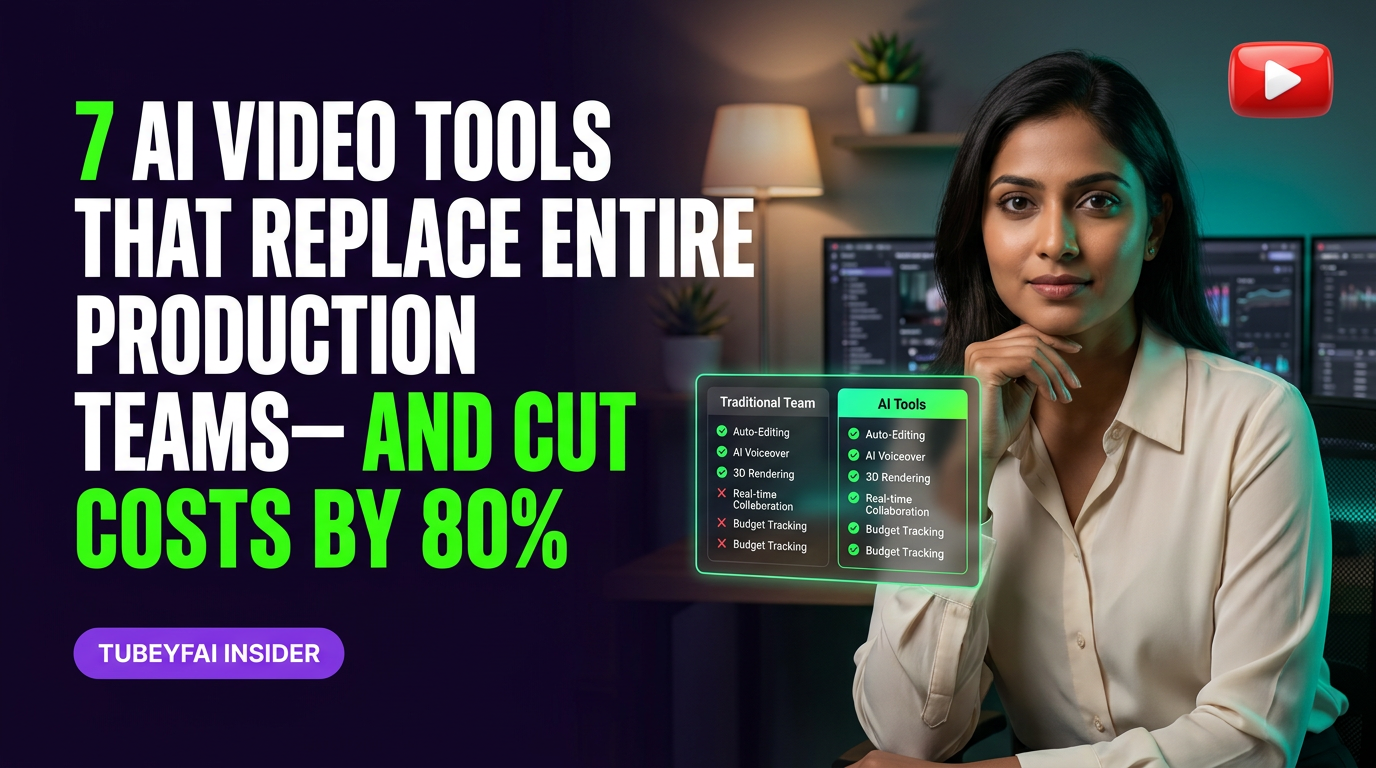
7 AI Video Tools That Replace Entire Production Teams—And Cut Costs By 80%
How Indian Creators and Marketers Can Leverage the Latest AI to Produce World-Class Videos Without a Crew
Imagine this: You’re sitting in your Chennai apartment with nothing but a laptop, and within hours you’ve produced a video that looks like it came from a studio staffed with writers, editors, animators, and directors. No frantic WhatsApp threads. No chasing freelancers. Just you—and AI.
Why “Video Production Team” Is Becoming Obsolete
Three years ago, launching a high-quality YouTube channel meant managing layers of human talent: scriptwriters, voiceover artists, video editors, motion designers, thumbnail pros—the list went on. Each role added cost and complexity. Today? The most advanced creators are quietly swapping entire teams for AI-powered workflows.
What’s driving this shift? It’s not just about cutting costs (though average reported savings range from 60-80%). It’s also about agility: rapid turnarounds, consistent quality, and the freedom to scale production without hiring headaches or missed deadlines.
Across my Silver and Diamond communities, I see patterns: channels producing 12-15 videos per month, hitting $8,000-$20,000/month in ad revenue—often with a single operator orchestrating everything via AI tools.
Let’s break down how these tools work—and why they’re already transforming the economics of content creation.
The AI Toolbox: What Can Be Automated?
It’s tempting to think of “AI video” as simple text-to-video magic. But today’s stack is much deeper:
Scripting & Ideation
ChatGPT 4o / Gemini Advanced: Generate research-backed scripts tailored for US audiences in minutes.
Content Outline Generators: Map out entire video series around trending topics or evergreen keywords.
Voice Generation
ElevenLabs / Play.ht: Hyper-realistic voiceovers—choose accents, genders, even emotional tone.
Descript Overdub: Instantly clone voices for branded narration or seamless corrections.
Video Editing & Assembly
Pictory / InVideo / Runway ML: Turn scripts into full-fledged videos—stock footage, animations, transitions—all handled automatically.
Adobe Premiere Pro + Sensei AI: Auto-cut reels, balance audio levels, and suggest dynamic cuts for pacing.
Visuals & Animation
Synthesia / HeyGen: Create talking-head avatars with customizable backgrounds—no actors required.
D-ID / Kaiber AI: Animate still images or generate B-roll on demand using prompts.
Thumbnails & Branding
- Canva Magic Studio / Midjourney V6: Design scroll-stopping thumbnails that match current trends (and A/B test them at scale).
Each tool handles what used to be an entire department—now available on monthly SaaS plans costing less than a single freelancer’s day rate.
How Cost Efficiency Translates Into Real Opportunity
Historically, building a faceless channel aimed at US viewers meant upfront investments: $2,000–$5,000/month just on staff and software. With modern AI stacks:
Typical all-in SaaS spend is now $100–$300/month
CPMs in tech/finance/health niches can reach $45–80 (based on public advertiser benchmarks)
Solo creators routinely manage multiple channels simultaneously
Time to first monetized video drops from weeks to days
That means more experiments per rupee spent—and more chances to hit those viral growth curves early.
Phase-by-Phase Timeline: Building an AI-Powered Video Channel
Here’s what adoption actually looks like across a typical 12-month journey:
Months 1–3: Laying Foundations
You’ll test core tools for scripting (ChatGPT), editing (Pictory/InVideo), and thumbnail design (Canva/Midjourney). Expect some friction as you tweak prompts and templates. Most creators produce their first 4–6 videos here—not all will perform.
Months 4–6: Scaling Output
By now you’ve refined your workflow. Batch-producing scripts becomes second nature; you move from idea to upload in under two hours per video. Channels often reach the crucial 1K subs/4K watch hour milestones here—and unlock AdSense monetization.
Months 7–12: Optimization & Diversification
With revenue coming in ($1k–$5k/month is common), you start experimenting:
Launching side channels in adjacent niches
Layering advanced analytics (vidIQ/Tubebuddy) for topic selection
Testing multiple voice models or avatar presenters for brand consistency
This is when true economies of scale kick in.
Year 2 Onward: Multi-Channel Empire Building
Successful operators automate even further:
Build prompt libraries for instant ideation
Integrate API workflows for bulk production
Reportedly, top players run 5+ channels solo—with total costs still under what one part-time editor would charge offline.
Who This Fits
This model isn’t just “for techies.” Across my communities I see results from:
Solopreneurs: Anyone comfortable experimenting with new tools can get started fast
Small Agencies: Scale client deliverables without ballooning headcount
Marketers: In-house teams producing explainer/brand content at startup speeds
Faceless Channel Builders: Those aiming for US/Tier 1 CPMs without the hassle of managing remote teams
If you’re motivated by leverage—doing more with less—it’s hard to beat this setup right now.
Who This Does NOT Fit
Despite the hype, not everyone will thrive here:
Traditionalists: If you need hands-on creative control over every frame or insist on shooting original footage
High-Budget Studios: For big-budget commercial shoots requiring bespoke cinematography or live talent
Ultra-Niche Content Creators: Channels built around hyper-local languages/cultures where current AI models lack nuance
Those Unwilling To Learn New Tech: There’s an initial learning curve—if you refuse to adapt or experiment with prompts/workflows, progress stalls
The best returns go to those willing to rewire their assumptions about “how video gets made.”
Where Are The Limits? And What Comes Next?
Today’s AI can handle scripting, voiceover, editing—even basic animation—with surprising polish. But there are edges:
Deep storytelling nuance may still benefit from human touch
Complex visual effects or cinematic sequences aren’t yet fully automated
Compliance/brand safety checks require manual review at scale
Yet the pace of change is relentless. Generative video models (like OpenAI Sora) are advancing monthly. SaaS platforms layer new features based on user feedback every quarter. Within the next year? Expect even more seamless integration—from prompt to publish—in minutes rather than hours.
How To Start Your Own Experiment—Without Risking Big Money
You don’t need huge capital or an engineering degree:
Pick one core use-case (YouTube explainers? Social clips? Product demos?)
Trial leading tools in each category using free credits/demos
Set up repeatable workflows—a template script structure, brand kit for thumbnails
Publish regularly; track which formats/topics outperform
Iterate based on real data—not guesswork or tradition
Your goal isn’t perfection—it’s speed of learning and compounding improvement over months 1–6.
The Bottom Line: Empowerment Through Automation
Here’s the punchline: AI isn’t just supporting video production anymore—it IS the backbone of modern content creation strategies. You can now replace five roles with five browser tabs—and redirect that budget into growth experiments instead of payroll stress.
That’s not science fiction—that’s already happening across faceless YouTube and marketing operations targeting premium markets worldwide.
Which tool will you try first? Which workflow breakthrough could double your output—or cut your costs by half?
Ready to go deeper?
Join my Free Webinar this Saturday — AI YADI Income Growth Matrix.