The US Insurance Niche: The $40-75 CPM Goldmine 90% of Indian Creators Ignore (And Why It's Perfect for Faceless YouTube)
Deep dive on the highest-CPM sub-niche from my 7-Niches breakdown last week. The 5 sub-niches inside insurance, the legal boundaries you must respect, realistic timelines, and why 90% of Indian creators self-select out of this goldmine.
The niche nobody's telling you about
Two days ago I published my list of 7 high-CPM faceless niches for July 2026. The email replies were predictable — most readers gravitated toward US Personal Finance (Niche 1) and Real Estate Investing (Niche 2). Familiar territory. Comfortable ground.
Almost nobody asked about Insurance.
Which is exactly why I'm writing this post.
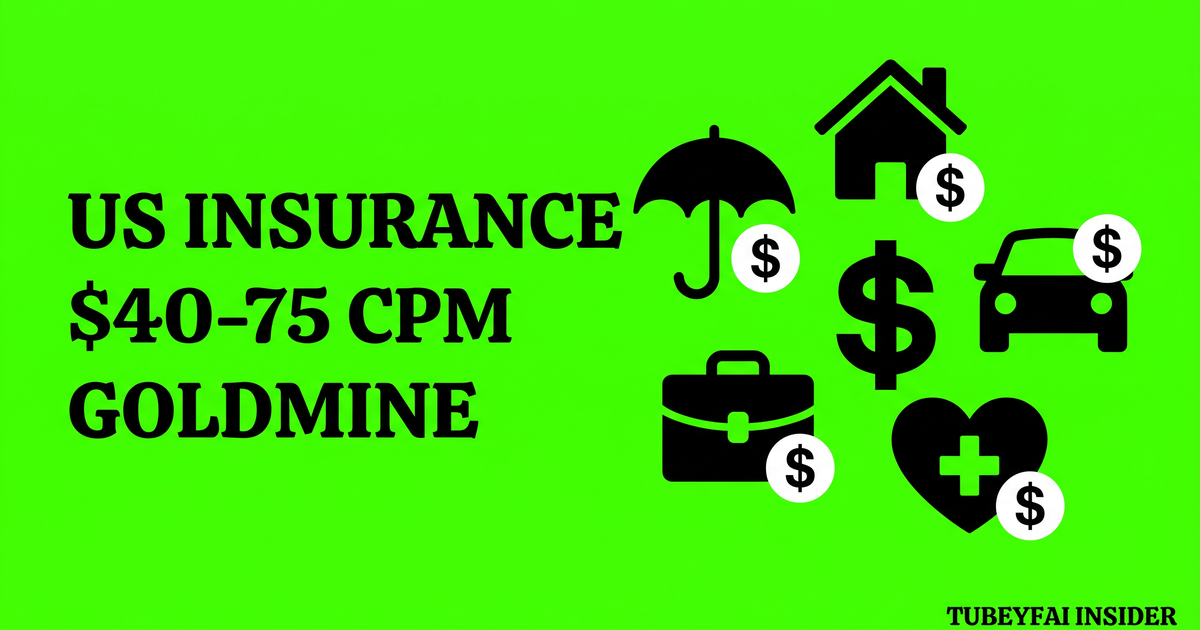
US Insurance is the highest-CPM opportunity in that entire list — reported ranges of \(40-75 based on publicly available advertiser benchmarks, with certain sub-categories pushing above \)90. It's advertiser-friendly, evergreen, and structurally suited for faceless content. And roughly 90% of Indian creators reading my last post immediately dismissed it because it "sounds boring" or "too complicated."
That dismissal is the opportunity. Every niche that sounds boring or complicated has one thing in common — the lazy competition self-selects out. What's left is a wide-open lane for anyone patient enough to build authority in a space most creators refuse to touch.
Here's the honest breakdown of the US Insurance niche in 2026 — why the CPMs are so high, which sub-niches to target, the legal boundaries you must respect, and who this niche genuinely fits.
Why insurance CPMs are so high
Insurance advertisers pay premium CPMs because their customer lifetime value is enormous. A single homeowners insurance policy is a multi-year revenue stream. A single life insurance customer can be worth $2,000-15,000 in commission to the agent placing the policy.
That economics translates to aggressive YouTube ad bidding. Look at the top-of-funnel metrics:
- Auto insurance advertisers report cost-per-acquisition in the $180-320 range for qualified leads
- Life insurance advertisers see CPAs as high as $600-900 for term life leads
- Health insurance CPAs run $250-450 depending on plan type and enrollment period
- Commercial insurance advertisers pay some of the highest CPMs on the entire platform because business owner audiences are so valuable
When advertisers are willing to pay \(300-900 per qualified click, they're willing to pay \)40-90 CPMs to get in front of the right viewer. That's basic ad-tech economics — advertiser willingness-to-pay drives creator revenue.
The 5 sub-niches inside US Insurance
Not all insurance content is equal. Here's where I'd focus in 2026, ranked by opportunity:
Sub-niche 1 — Life Insurance Explained (highest advertiser LTV)
Life insurance advertisers have the deepest pockets because policies last 10-30 years. Content that works here: "term vs whole life for a 35-year-old," "how much life insurance do I actually need," "what happens if you skip the medical exam," "final expense insurance for parents."
Reported CPM range: $45-80. Competition: Low — most creators avoid life insurance because it feels morbid.
Sub-niche 2 — Auto Insurance Deep Dives (broadest audience)
Every American with a driver's license needs auto insurance. Content works because it's practical: "how to actually shop auto insurance," "what raises your rates most," "when is Progressive better than Geico," "SR22 explained."
Reported CPM range: $35-60. Competition: Moderate — a few big channels dominate but sub-angles are wide open.
Sub-niche 3 — Health Insurance for Specific Situations
The general health insurance space is crowded, but SPECIFIC situations aren't: "COBRA explained after job loss," "Medicare Advantage vs Original Medicare," "high-deductible health plans + HSA strategy," "health insurance for early retirees before 65."
Reported CPM range: $40-75. Competition: Low in specific-situation content, high in general overviews.
Sub-niche 4 — Homeowners and Umbrella Insurance
Fastest-growing sub-niche in 2026 due to natural disaster claims driving premium increases nationwide. Content works: "why homeowners insurance is spiking in Florida/California," "do I need umbrella insurance," "what your policy actually covers in a flood."
Reported CPM range: $40-65. Competition: Low — genuinely open lane.
Sub-niche 5 — Small Business Insurance
The absolute highest-paying insurance content because business owner audiences convert on $5,000+ policies. Content: "general liability insurance explained for freelancers," "workers comp for a 3-person business," "cyber insurance for small businesses."
Reported CPM range: $55-95. Competition: Very low — expertise barrier keeps casual creators out.
Why insurance is uniquely faceless-friendly
Traditional insurance YouTubers are almost always licensed agents doing face-camera videos. That format has three inherent limitations:
- Agents can only recommend policies they're licensed to sell — limits content variety
- Face-camera limits production volume — one video per week is typical
- Agent brand is tied to a specific state license — limits national audience
Faceless AI channels bypass all three:
- You're not selling policies. You're educating. Massively wider content variety allowed.
- AI production stack (Claude Code + Higgsfield + ElevenLabs) enables 3-4 videos per week easily.
- No state license limitation — content is educational, not advisory.
That structural advantage is why faceless insurance channels are currently outgrowing agent channels in the segment.
The legal boundary you must respect
This is where most creators mess up and get themselves in trouble.
What you CAN do without a license:
- Explain how different insurance products work
- Discuss general strategies (when to increase deductibles, when to add riders)
- Compare policy types (term vs whole life as concepts, not specific products)
- Educate on regulatory changes (Medicare enrollment periods, ACA updates)
- Share your own personal insurance decisions and reasoning
What you CANNOT do without a license:
- Recommend specific insurance policies to specific viewers
- Provide personalized advice ("You should buy X policy from Y company")
- Sell insurance products through affiliate links (some states restrict this heavily)
- Claim to be a licensed advisor in any state where you're not licensed
The safe framework: Every video ends with "This is educational content, not licensed insurance advice. Consult a licensed insurance agent in your state for guidance on your specific situation." That single disclaimer keeps you clean legally.
If you follow this framework, you can build a US insurance YouTube channel from Chennai without ever needing a US license, without ever selling a policy, and without ever crossing into regulated advice territory.
The content format that actually works
Here's the structural pattern that performs best in this niche:
Format: 8-14 minute explainer videos with a clear "situation → mechanism → decision framework" arc.
Opening (0-90 seconds): Name the specific problem the viewer has. "You just got a homeowners insurance renewal 40% higher than last year. Before you switch companies, you need to understand why this happened and whether switching actually helps."
Body: Walk through the underlying mechanism — how insurance pricing actually works, what the industry data shows, what similar situations have looked like historically.
Framework: Give the viewer a decision tree they can apply to their specific situation. Never tell them what to do. Tell them how to think about it.
Close: The educational disclaimer, plus a CTA to another related video (per the July 2026 algorithm shift I covered last week).
Realistic timeline expectations
I'll be direct here since insurance channels behave differently from typical faceless niches.
Months 1-3: You'll publish 12-15 videos. Views will be low (500-3,000 per video typically). Don't panic. Insurance content requires cluster depth before YouTube's algorithm starts treating your channel as authoritative in the space.
Months 4-6: If your content quality has been consistent, you'll start seeing 5,000-15,000 view videos and CPMs stabilizing around the $25-40 range.
Months 7-12: Cluster authority kicks in. Search discoverability improves dramatically (people actively search insurance terms). Best videos start pulling 50,000-200,000 views. CPMs move into the $40-70 range on your best-performing content.
Year 2 onward: With 100+ videos across tight clusters, this is where insurance channels really compound. Your library becomes a searchable evergreen asset. Older videos keep earning while new videos build. This is the "long tail" that makes insurance a smarter long-term bet than trend-chasing niches.
Total revenue potential at scale: A well-executed insurance faceless channel with 100+ videos and consistent audience can reasonably target $8,000-20,000/month in ad revenue alone within 18-24 months.
Who this niche fits
- Creators genuinely interested in how financial systems work
- People with any professional background touching insurance, finance, or law
- Anyone who reads industry reports or SEC filings recreationally
- Patient creators — this is a 12-24 month build, not a 3-month sprint
Who this niche does NOT fit
- Creators looking for viral hits
- People who dislike detailed research
- Anyone unwilling to publish consistent, high-effort educational content
- Creators who need short-term revenue (this is a slow-compound niche)
How to get started this week
If you're seriously considering this niche:
Step 1: Watch the top 20 most-viewed videos in your chosen sub-niche. Take notes on their structure — what works, what doesn't, where they leave gaps you could fill.
Step 2: Read the National Association of Insurance Commissioners (NAIC) website — the primary regulatory source. Their public data and reports are goldmines for content.
Step 3: Pick a sub-niche and commit to publishing 12 videos in 90 days. No exceptions, no perfectionism. Publish first, refine later.
Step 4: After 12 videos, do a data review. What retained? What didn't? Refine and continue.
Ready to go deeper?
Join my Free Webinar this Saturday — AI YADI Income Growth Matrix. I'll walk you through:
- Live niche validation for the insurance sub-niche you're considering
- The specific research workflow for extracting content ideas from NAIC data using Claude Code
- How the AI stack (Claude Code + Higgsfield + ElevenLabs) handles legal-adjacent content safely
- Live Q&A on your specific situation
Register here for the Free Webinar →
The insurance niche isn't sexy. It's not trending. It doesn't get you likes on Instagram. It just quietly compounds into one of the most defensible YouTube businesses you can build. Which side of that trade are you on?