RPM vs CPM: the $8,000/Month Difference Most Indian Creators Overlook
Most creators think CPM is their real earning power—until RPM tells a different story.
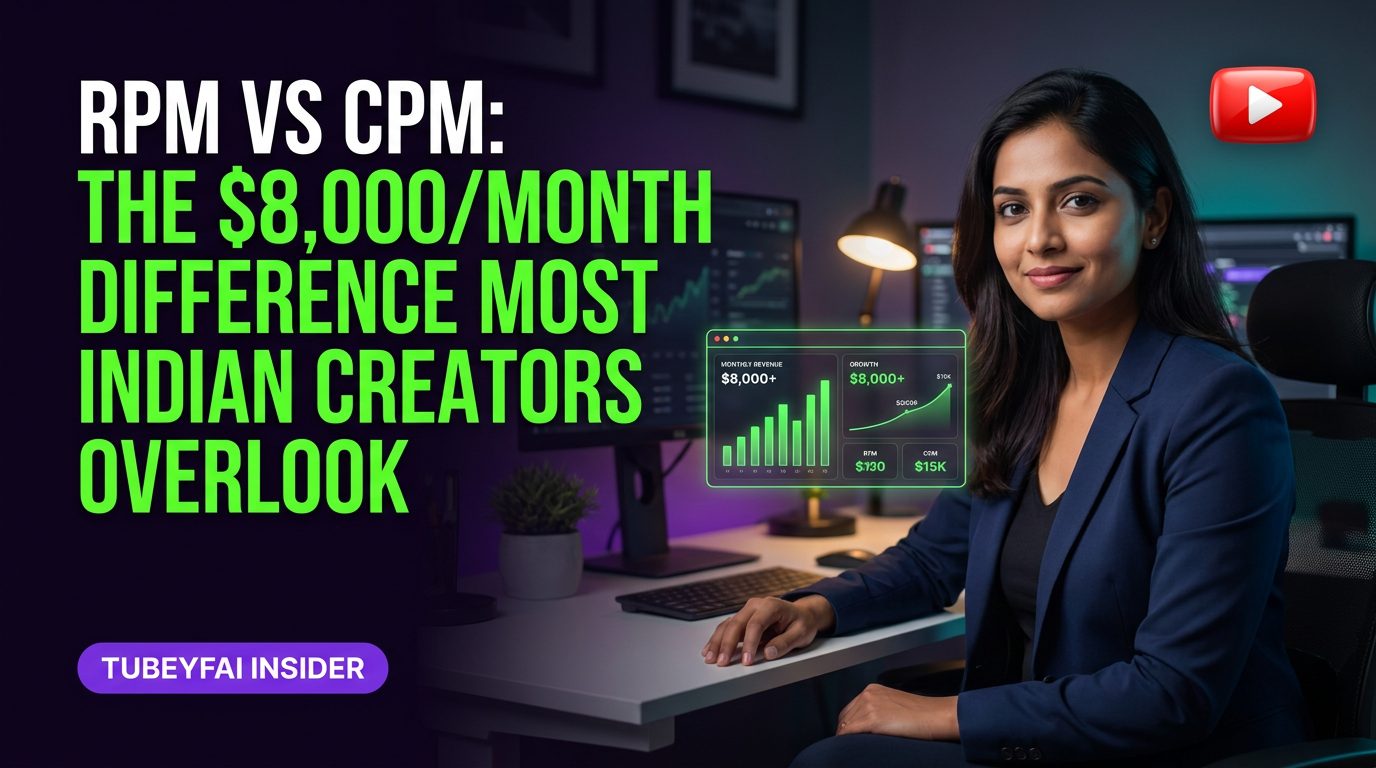
My first YouTube payout was a shock. I’d seen videos bragging about $60+ CPMs, so I built my channel for US tech audiences and ran the math: “If I get 100,000 views, that’s $6,000!” But when the deposit landed in my account, it wasn’t even half that number. Where did all that ad money go? Turns out, like most creators starting out, I had confused CPM (Cost per Mille) with RPM (Revenue per Mille). That single misunderstanding cost me months of planning—and thousands in missed revenue.
In this deep dive, I’ll break down exactly what separates CPM from RPM, why this difference matters for your monetization strategy, and how you can finally take control of your true earnings potential as an Indian creator building for US and Tier-1 markets.
Why Most Creators Get Burned By The RPM vs CPM Trap
YouTube’s own dashboards don’t make it easy. CPM is everywhere in analytics—ad rates look sky-high. But your actual payout? That’s governed by RPM, which sits quietly in a separate tab or summary line. This confusion isn’t just academic; it leads to overestimating income projections by as much as 40-60%.
Common Misconceptions:
“CPM = What I earn per thousand views.” (False)
“Higher CPM means more money in my pocket.” (Only partly true)
“If my CPM goes up, so will my monthly payout.” (Not always)
I’ve seen these misunderstandings across hundreds of channels—from brand-new Indian creators to those already hitting 1 million+ views per month.
Breaking Down The Metrics: CPM vs RPM
Let’s get crystal clear:
What Is CPM?
CPM stands for Cost per Mille (thousand). It represents the amount advertisers are willing to pay for 1,000 ad impressions on your content. This figure is set by advertiser demand in your niche and geography.
Example: If your channel has a $45-$80 CPM (common range for US finance or tech niches), advertisers are paying YouTube $45-$80 per thousand ad impressions.
What Is RPM?
RPM stands for Revenue per Mille (thousand)—what you actually earn per 1,000 video views after YouTube takes its share and only counting monetized activity.
Calculation:
RPM = (Total Revenue / Total Views) x 1,000
It includes:
Ad revenue
Channel memberships
Super Chat
YouTube Premium revenue
But here’s the kicker: Not every view gets an ad. And YouTube takes a 45% cut of ad revenue, plus there are non-monetized views.
Key Differences At A Glance
| Metric | Who It Reflects | Calculation | Typical Range (US Tier-1 Niches) |
|--------|----------------|-------------|----------------------------------|
| CPM | Advertiser | Per 1k monetized ad impressions | $45–$80 |
| RPM | Creator | Per 1k total views | $8–$20 |
So if you see a channel touting a $65 CPM but their RPM is only $12—that’s not incompetence. It’s how the system works.
How These Metrics Shape Your Actual Earnings
Imagine two Indian creators targeting US viewers:
Creator A: Sees a reported $70 CPM on finance videos.
Creator B: Notices their RPM is stuck at $14 despite similar topics.
The disconnect? Only around 35-50% of total views get ads served, especially with global traffic or non-signed-in users. Plus, YouTube keeps nearly half the gross ad spend before passing you your cut.
Here’s a simplified breakdown using reported benchmarks:
100,000 US-based views
Advertisers pay: ~$7,000 (@$70 CPM)
After YouTube cut: ~$3,850
Ads shown to ~50% of viewers: Effective payout = ~$19.25 RPM
That means if you’re forecasting earnings based on CPM alone (“100k x $70/1000”), you’ll end up expecting double—or even triple—your real take-home amount!
Timeline To Mastery: Understanding & Leveraging Monetization Metrics
Months 1–3: Reality Check & Analytics Deep Dive
Most new creators fixate on subscriber milestones or viral hits. Instead:
Dive into both CPM and RPM metrics from day one.
Track differences between geographies—US/Tier-1 vs India/SEA.
Identify what percentage of your views are monetized.
Expect confusion and emotional whiplash as expectations meet reality—but this phase builds essential literacy.
Months 4–6: Content Strategy Adjustments
Now that you know where money actually flows:
Double down on formats/niches with higher effective RPM.
Test thumbnails/titles to attract more signed-in Tier-1 viewers (who see more ads).
Begin optimizing upload times for US primetime hours.
Channels in my community report consistent increases from ~$8 to ~$15 RPM within this window through targeted tweaks—even if their raw CPM doesn’t budge much.
Months 7–12: Scaling With Precision
With data-driven clarity:
Launch additional faceless channels targeting other high-RPM verticals.
Negotiate brand deals with realistic expectations grounded in actual earnings power.
Experiment with longer-form content to increase mid-roll ad slots—further boosting total revenue without chasing viral spikes alone.
Reported patterns show many channels reaching stable revenues of $8,000–20,000/month by month 12, but only after embracing the real-world gap between CPM hype and RPM reality.
Year 2 Onward: Advanced Monetization Tactics
Once you’ve mastered the basics:
Layer on direct sponsorships and affiliate offers based on proven audience value—not just high advertised CPMs.
Use membership/superchat features to diversify beyond fluctuating ad rates.
The highest-performing channels in my Silver and Diamond communities actively use RPM tracking as their north star—not just vanity metrics like raw view counts or theoretical CPM ceilings.
Who This Fits
This approach will unlock massive growth if:
You’re an Indian creator building faceless channels for US/Tier-1 audiences
You want reliable income projections—not guesswork
You’re ready to optimize content with data-first strategies
Transparency about real earnings motivates you more than superficial dashboard highs
Who This Does NOT Fit
If any of these ring true, this post might frustrate more than help:
You only care about viral view counts—not sustainable revenue
Your primary focus is local/regional audiences where low ad fill rates are unavoidable
Detailed analytics bore or overwhelm you—you prefer pure creative flow
You expect overnight success without iterating based on data
Why Knowing The Difference Is Everything For Serious Creators
If you’re still measuring success by flashy CPM numbers alone, you’re setting yourself up for disappointment—and leaving serious money on the table. Real mastery comes from knowing exactly what each metric tells you about your business model:
Knowing the difference between RPM and CPM isn’t just a numbers game—it’s the key to unlocking smarter monetization decisions and maximizing your revenue.
Are you still letting misleading dashboard numbers dictate your strategy—or are you ready to build wealth on facts?
Ready to go deeper?
Join my Free Webinar this Saturday — AI YADI Income Growth Matrix.
About the author
- Aviation-Professional-Turned-AI-YouTube-Automation-Coach who's spent 9+ years turning knowledge into income through YouTube, AI Agent Automation, Digital Products, Instagram — YADI without ever showing his Face.
Niche Research
How to find and validate high-CPM YouTube niches that pay in USD — data-driven niche selection strategies for faceless channels targeting US and Tier-1 audiences.